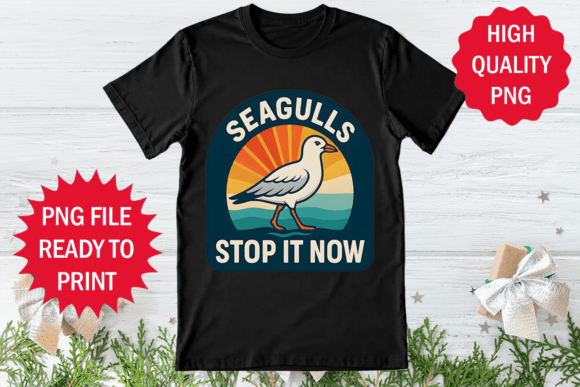
Vintage Seagulls Design T-shirt Clipart
First Impressions: Nostalgic, Light, and Unexpectedly Versatile
When I opened the Vintage Seagulls Design T-shirt Clipart, I didn’t see just another beach-themed graphic—I saw a quiet invitation to slow down. The composition feels hand-drawn but intentional: three stylized seagulls in flight, arranged with gentle asymmetry, their wings echoing curves rather than sharp angles. There’s warmth in the palette—soft coral, sky blue, sandy beige—not oversaturated, not trendy-for-trend’s-sake. It breathes. That matters more than you’d think when translating a flat graphic into thread.
A Real Project Test: Embroidering a Linen Tote for a Coastal Boutique
Last week, I prepped this design for a custom linen tote bag—part of a small batch for a seaside gift shop. Not screen-printed. Not heat-pressed. Fully embroidered. Why? Because their customers pay extra for handmade texture and quiet storytelling. The Vintage Seagulls Design T-shirt Clipart held up beautifully in that context: its open negative space let the natural slub of the linen show through, and the simplified wing contours translated cleanly into satin stitch without overcrowding the fabric. No tiny beaks to vanish under dense fill. No micro-details begging for 60-stitch-per-centimeter precision. Just confident, readable shapes—exactly what you want when stitching on textured, medium-weight natural fiber.
Where It Shines (and Where It Asks for Thought)
This isn’t a one-size-fits-all embroidery file—and that’s a strength. It excels in projects where charm outweighs complexity:
- Embroidered tote bags and canvas aprons — the scale reads clearly at 3.5–4.5 inches wide, and the clean lines resist distortion on slightly uneven surfaces;
- Baby onesies and nursery pillows — soft curves feel gentle, non-gendered, and ageless; no harsh edges or aggressive contrast;
- Sweatshirt chest logos and cap fronts — it avoids the “too busy” trap many clipart-style graphics fall into on curved, stretchy, or thick substrates;
- Embroidered patches and tea towel monograms — works as both standalone motif and part of a curated set (think: pairing with a vintage anchor or sailboat graphic).
But it’s not magic. On ultra-thin baby rib knit? Proceed carefully—check stitch density first. On dark fabric? Confirm your thread colors have enough value contrast—those light coral wings need breathing room, not visual sinking. And on caps? Always test hoop placement: the topmost gull’s wing shouldn’t get cropped by the curve of the crown.
What It Does for Your Handmade Product—and Your Customer’s Perception
There’s a subtle psychological lift here. Vintage Seagulls Design T-shirt Clipart doesn’t shout. It invites recognition—not “Oh, a seagull!” but “Oh—that feeling. Salt air. Early morning walks. Quiet confidence.” That resonance elevates a simple embroidered tote from “nice” to “meaningful.” For Etsy sellers and small shop owners, that’s commercial gold: customers don’t just buy the item—they buy the mood it carries. It also supports brand consistency without locking you into a rigid aesthetic. Pair it with neutral apparel, earthy packaging, and handwritten tags, and it feels cohesive—not forced.
Practical Embroidery Designer Notes You’ll Actually Use
Before stitching your first piece, do these five things:
- Test on scrap fabric — especially if using it on sweatshirt fleece or textured linen. Watch how the fill stitch settles into the nap;
- Review thread color contrast — try it in both light-on-dark and dark-on-light mockups. That coral wing loses impact on navy unless you boost saturation or add an outline;
- Check stitch density — overly dense fill can flatten the design’s airy feel. If your machine allows, reduce density 5–10% for breathable fabrics;
- Confirm hoop size and placement — this design flows best centered or slightly left-aligned on chest placement. Avoid cramming it into tight corners or near seams;
- Verify licensing for commercial use — since it’s labeled as Graphics and T-Shirt Designs, confirm whether resale of finished embroidered items is permitted. When in doubt, contact the seller before listing on Etsy or filling wholesale orders.
Not Just for T-Shirts—A Quiet Workhorse for Craft Business Needs
Yes, it’s marketed as a T-shirt design—but its real utility lies beyond print. As a digital embroidery file, it adapts cleanly to stitched patches, personalized baby blankets, holiday kitchen towels, and even minimalist wedding favor tags. I’ve used it as a subtle repeat motif along the hem of a cotton napkin set—stitched in ecru thread on oat-colored linen—and it read as bespoke, not clipart. That’s the sign of thoughtful design: it supports your craftsmanship instead of competing with it.
A Final Thought for Makers Who Value Integrity Over Impulse
Vintage Seagulls Design T-shirt Clipart won’t solve every embroidery challenge. It won’t replace custom digitizing for intricate lettering or photorealistic detail. But it *does* deliver something rarer in the digital design marketplace: clarity of intent, restraint in execution, and quiet adaptability across real-world handmade products. If your craft business values authenticity over algorithm-driven trends—if your customers choose your work because it feels considered, not curated—this is a design worth testing, stitching, and trusting.